

Summary
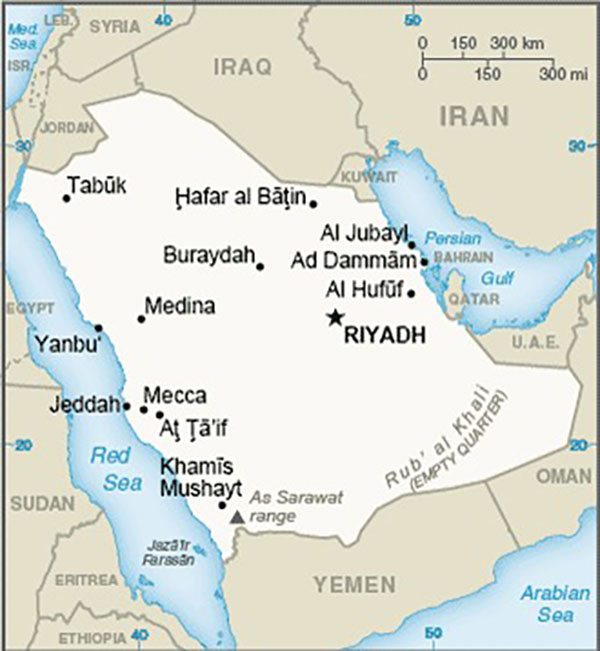
Map of Saudi Arabia
The Kingdom of Saudi Arabia is an absolute monarchy and Islamic state governed by the dynasty of the House of Saud. The Basic Law issued in 1992 states that the Koran is Saudi Arabia’s constitution. The country is regularly ranked among the “worst of the worst” dictatorships in Freedom House’s annual Freedom in the World report.
The Arabian peninsula is home to nomadic and sedentary tribes of Bedouins and Arabs, the latter migrating from the Fertile Crescent around 900 BCE. Arabia was united in the 7th century CE by armies of the Prophet Muhammad, the founder of Islam. It later disunited, falling under the political dominance of the Ottoman and British Empires. The Kingdom of Saudi Arabia, comprising most of the peninsula, was established in 1932 as a unified Islamic state by Abdulaziz (also known as Ibn Saud). The discovery of oil in 1938 enriched the Kingdom, helped to maintain the monarchy’s control and made the Kingdom a major power in the Middle East and globally.
The Kingdom of Saudi Arabia is an absolute monarchy and Islamic state governed by the dynasty of the House of Saud. . . . [It] is regularly ranked among the “worst of the worst” dictatorships in Freedom House’s annual Freedom in the World report.
The current king has delegated much of his governing authority to his son, Mohammed bin Salman, whom he named Crown Prince (or heir) in 2017 and prime minister in 2022. Mohammed bin Salman initiated some reforms but has consolidated power through repression of competitors within the royal family and even harsher repression of dissent within Saudi society.
Under a partnership with the monarchy, judicial functions are exercised by an Islamic religious establishment. A few aspects of Shari’a law have been eased recently, but the Islamic courts continue to impose long prison sentences, corporal punishment and death for the exercise of basic freedoms.
Saudi Arabia is surrounded on three sides by water (the Red Sea, the Persian Gulf, and the Arabian Sea) and bordered by three land states to the north and five Gulf states. The 15th-largest country in the world by area, Saudi Arabia has a total population of 32 million (one-third are foreign workers). According to the International Monetary Fund, the economy ranks 19th largest in the world with a 2024 projected nominal Gross Domestic Product (GDP) of 1.1 trillion. Saudi Arabia places 35th in per capita income (at $30,040 per annum).
History
Ancient History
Modern human habitation on the Arabian peninsula, sitting between the Persian Gulf and the Red Sea, dates to 75,000 years ago with migration from eastern Africa. Peoples on the peninsula developed among the first written languages, dating from 3200 BCE. Semitic language-speakers migrated to Mesopotamia, Asia Minor and southwestern Asia. Arabia's numerous tribes used the peninsula's central location to engage in trade, especially along the coasts of Oman and Yemen. Trade routes expanded north and east.
The peninsula’s population of Arabs, (whose origins in Biblical tradition are said to be the progeny of Abraham’s son Ishmael) dates to 900 BCE with migration from the Fertile Crescent to the north. Three major kingdoms arose on the peninsula but fell in the first century CE to the Roman Emperor Trajan.
The Birth of Islam
Arabia’s most consequential events center around the Prophet Muhammad and the rise of Islam. At Muhammad's birth in 570 CE, the peninsula was divided among polytheistic Arabic and Bedouin tribes of traders and nomads. The center of trade was the city of Mecca. Muhammad belonged to its most prominent tribe, the Quraysh.
Arabia’s most consequential events center around the Prophet Muhammad and the rise of Islam.
According to Islamic history, Muhammad was visited in a vision in 610 CE by the archangel Jibril, or Gabriel, as God's messenger. At first doubtful, Muhammad was convinced of the visions’ validity as he continued to receive them over the next 23 years. He sought followers who would be faithful to the messages, which he dictated to scribes, of the one true God, or Allah. Islam is one of three Abrahamic religions. Sacred scriptures for Muslims are the Holy Koran, which are the word of Allah as related by Muhammad, with reference to the Biblical tradition of Judaism and Christianity.
The Quraysh tribe relied on pilgrimages of pagans for its trade and largely rejected Muhammad's prophetic message. Muhammad and his early followers then went to Medina in 622 CE to build an army. In 629 Muhammad returned to seize Mecca and by 630 had conquered the entire Arabian Peninsula to unite the tribes of Arabia around the monotheistic religion of Islam.
The Rise of Islam
Following Muhammad’s death, Islam spread through trade, travel and warfare. By the 8th and 9th centuries, conversions and the Islamic conquests reached as far West as Spain and as far north as Central Asia. Later, Islam spread to sub-Saharan Africa, southern Russia, parts of Europe controlled by the Ottoman Empire, as well as southwest Asia and the Pacific.
The center of the Muslim world switched from Mecca to Damascus and then Baghdad, where succeeding caliphates, or religious realms, were based. The last Sunni caliphate was based in the Ottoman Empire and formally ended in 1922. The minority sect of Shi’a Islam split from Sunni Islam in a violent schism over the legitimacy of the early caliphs. (Shi’ites recognize valid succession based solely on family relationship to Muhammad.) Shi’ite followers today are a majority in Azerbaijan, Bahrain, Iran and Iraq but a minority elsewhere. Sunni followers are dominant in most Muslim countries.
Due to its history as the birthplace of Islam, Saudi Arabia plays a special role for the world's entire Muslim community of 1.2 billion people as home to Islam's two most sacred cities, Medina and Mecca.
The branches of Islam differ in their doctrines, but share many of the same beliefs and practices. Due to its history as the birthplace of Islam, Saudi Arabia plays a special role for the world's entire Muslim community of 1.2 billion people as home to Islam's two most sacred cities, Medina and Mecca. Its religious authorities host the annual pilgrimage, or hajj, to Mecca, one of the five main duties, or pillars of faith, of all Muslims. A Muslim is obliged to make the hajj at least once in a lifetime if possible. Each year around two million visitors make the pilgrimage to Mecca (see also History in Religious Freedom).
The Beginnings of Modern Saudi Arabia
Unlike most other Arabic-speaking countries, Saudi Arabia was never fully conquered or colonized. The Romans in ancient times and then the Egyptians and Ottomans all vied for control of trade and influence in the Arabian Peninsula, but none subjugated it fully due to the forbidding climate and geography. Arabia continued to be a center for trade, especially as a route to India and other parts of Asia. It also became one of several routes in the Islamic slave trade, with persons trafficked from Sudan and Ethiopia (trafficking continued until stopped following World War II).
Abdal Wahhab needed a backer to propagate his campaign for religious purification [while] Muhammad bin Saud sought to unify the peninsula around the House of Saud.
Saudi Arabia has roots in religious revivalism in the central region of Najd, near today’s capital of Riyadh. In the early 18th century, Muhammad ibn Abd al-Wahhab, a Muslim cleric, began propagating a "unitary" or fundamentalist interpretation of Sunni Islam based on its earliest tenets. His followers were called Muwahhidun or "Unitarians," known as "Wahhabi" by non-Muslims.
Abdal Wahhab needed a backer to propagate his campaign for religious purification. He turned to the most powerful man in the Najd region, Muhammad bin Saud, the patriarch of the wealthy Saud family. For his part, Muhammad bin Saud sought to unify the peninsula around the House of Saud. The two men formed a partnership in 1744 through a traditional Muslim oath. Each pledged to create a centralized state according to Islamic principles.

A depiction in an early Saudi kingdom publication of the traditional oath between Abdal Wahabbi and the Emir of the Saud dynasty, Muhammad bin Saud, and its prince, Abdulaziz bin Saud. The oath intertwined religious fundamentalist authority and the state and remains a foundation of the modern Saudi Kingdom. Public Domain.
This oath remains the Saudi kingdom's foundation today. By the time of Muhammad bin Saud's death in 1765, he had secured control over Najd and made Wahhabism the dominant faith. In the early 19th century, Muhammad bin Saud's sons expanded the reach of Wahhabism to the rest of the Arabian Peninsula, including Mecca and Medina, as well as further north.
The Founding of Saudi Arabia and the Discovery of Oil
Throughout the 19th century, the Al Saud rulers had to thwart attempts by the Egyptians, the British and Ottomans to conquer Arabian territory. In 1902, after a period of infighting, Abdulaziz, known as Ibn Saud in the West, reasserted his family's control over the central Najd region, including Riyadh. By allying with local leaders and a Bedouin group known as Ikhwahn, Abdulaziz completed conquests of other parts of the peninsula, except for coastal cities where the British set up separate ruling kingdoms. (These are the origin of today’s other Arabian Gulf states.)
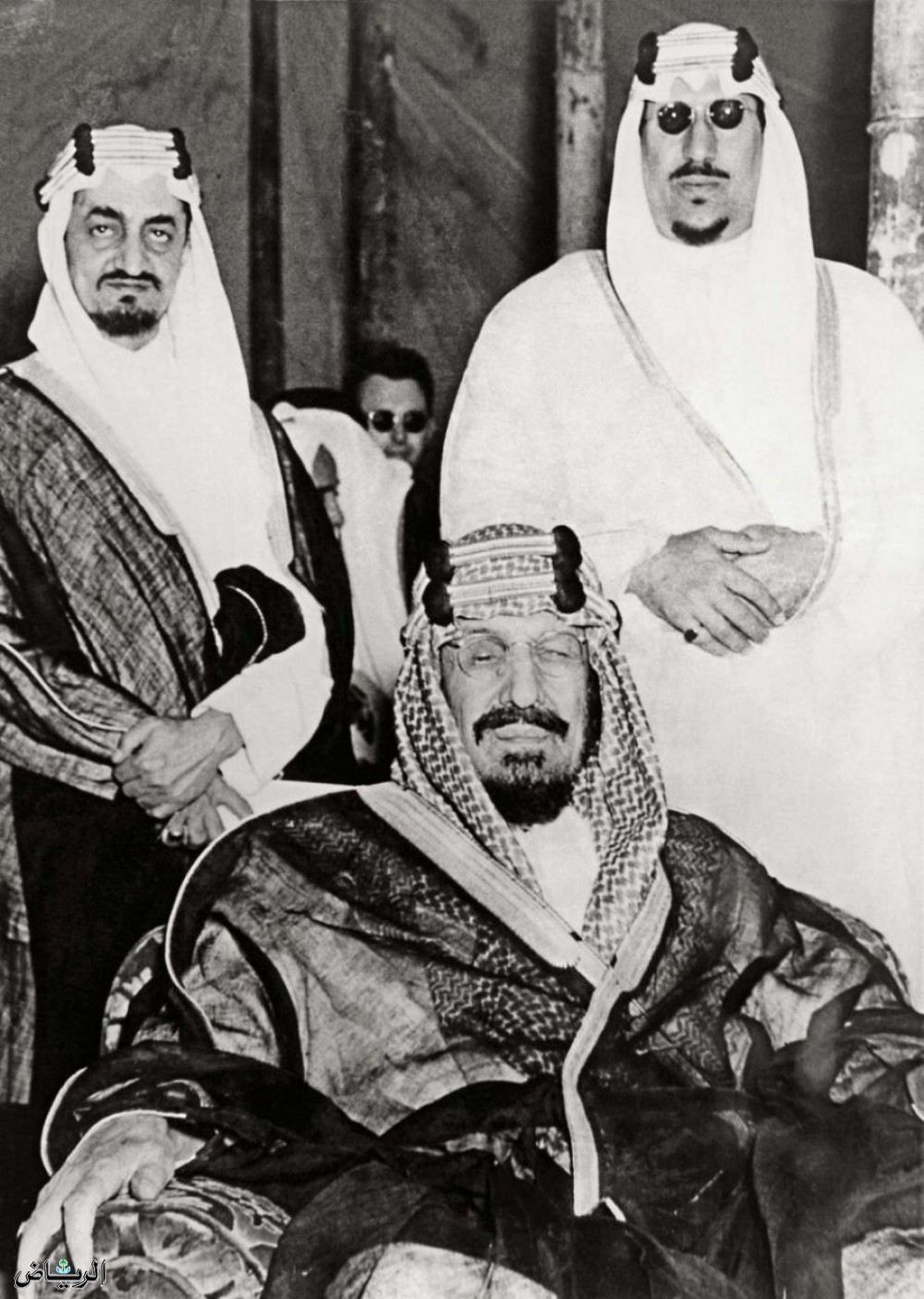
Abdulaziz bin Saud (center) consolidated four regions as the Kingdom of Saudi Arabia in 1932, establishing the Saud dynasty. He ruled until 1954. His sons have ruled since to this day. Above are Abdulaziz and his two immediate successors standing, Prince Saud (right) and Prince Faisal (left). The current king is Salman, a later son born in 1935.
In 1932, Abdulaziz declared the regions under his control the Kingdom of Saudi Arabia. Building a state on the basis of conflicting and competing tribal groups proved difficult. King Abdulaziz battled frequently against opponents of innovation. (One example was establishing a radio station. He convinced tribal elders and imams of its worth as a means to broadcast the Koran.)
In 1932, King Abdul granted exploration rights to the Standard Oil Company of California (later called Chevron). In 1938, there was successful drilling of the then-largest known oil deposit in the world, leading to drastic change in all the Arabian kingdoms that ruled on the peninsula and most of all Saudi Arabia. It was found that the kingdom held 25 percent of the world’s known oil reserves and immediately became the top oil producing country in the world. It has remained among the top oil producers since.
The Saudi Kings and Saud Family
King Abdulaziz ruled from 1932 to 1953. He controlled all appointments to the kingdom's executive, legislative and judicial bodies and made all law by decree. Government and economic positions were reserved for male members of the expanding Al Saud dynasty.
King Abdulaziz . . . controlled all appointments to the kingdom's executive, legislative and judicial bodies and made all law by decree. Government and economic positions were reserved for male members of the expanding Al Saud dynasty.
King Abdulaziz had 45 sons and more than 50 daughters by 22 wives (he married a daughter of every tribal leader). Thirty-six male heirs survived to adulthood and themselves had multiple wives and children. Today, all important government posts are held by princes of the royal family, which owns or controls most of Saudi Arabia's economic assets. Thousands of family members benefit from stipends, scholarships abroad and other privileges.
Abdulaziz was known for moderate behavior, but his first son and successor, King Saud (1954-64), had an extravagant lifestyle and mismanaged state revenues. Forced to abdicate by a royal family decree, he was replaced by the next oldest son, Faisal (1964-75). Adopting the modest behavior of his father, Faisal also modernized the economy and improved the educational system.
After Faisal was assassinated by a disgruntled nephew, the next of Abdulaziz’s sons to reign were Khalid (1975–82), Fahd (1982–2005), Abdullah (2005–2015) and the current king, Salman (2015–present). In 1992, King Fahd codified the succession by a Crown Prince named by the king when he issued the Basic Law, which now serves as a constitution.
In 2007, King Abdullah modified the practice of succession by creating an Allegiance Council from within the royal family to determine a successor. But it has functioned more as a rubber stamp and approved Abdullah’s choice of his brother Salman as Crown Prince in 2012. Upon becoming king in 2015, Salman gained approval to designate members of the next generation as Crown Princes and so bypassing the last of the aging sons of Abdulaziz. The first Crown Prince named was the king's nephew, Muhammad bin Nayef, but he was soon replaced by the king’s own son, Mohammed bin Salman (see also below).
Oil and Foreign Policy
After establishing the Kingdom of Saudi Arabia, Abdulaziz adopted a policy of neutrality. Nevertheless, the king broke diplomatic relations with Germany in 1939 and Japan in 1941 and provided oil to the Allies. In 1945, he allowed the United States to build an air base.
During the Cold War, Saudi Arabia became an ally of the United States and opposed the Soviet Union’s expanding influence in nationalist and socialist states like Egypt, Syria and Iraq. Yet, Saudi Arabia joined all other Arab states in opposing UN resolution 181 that partitioned Palestine and led to the establishment of Israel. It did not formally declare war but did send volunteers to fight in both the 1948 and 1973 wars.
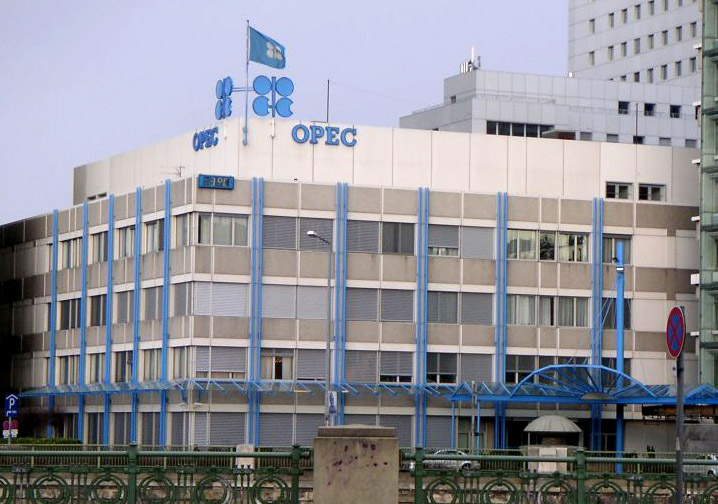
In 1973, King Faisal organized a cartel of oil producing states, OPEC, causing major world economic disruption. OPEC, with its headquarters in Vienna, continues to play a large role in oil production and prices, most recently restricting production to raise prices after Russia’s invasion of Ukraine. Creative Commons. Photo by Priwo
After the 1973 Yom Kippur War, Saudi Arabia led major oil-producing states in forming a cartel, the Organization of Arab Petroleum Exporting Countries (OPEC), which imposed an embargo on countries supporting Israel. This caused major economic disruption in the United States and Europe. OPEC continues to play a decisive role in setting world oil production and prices, most recently by limiting production and thus increasing prices in agreement with Russia following its invasion of Ukraine in February 2022.
In the last thirty years, the kingdom’s main focus shifted to combat the spread of the Muslim Brotherhood, which originated in Egypt as an anti-monarchical movement, as well as the Shi’ite theocracy of Iran and Syria, whose Alawite leadership has allied with Iran to defeat a rebellion (see Country Studies).
Domestic Policy
Domestically, the Saudi Kings continued King Faisal’s modernization and education policies, but the government remained highly repressive and insular due to its dominant practice of “religious purification.” The government made minimal attempts to diversify its economic base and the vast majority of the kingdom's revenues continued to come from oil. The education system built by King Faisal benefitted mostly the elite (much of the royal family is sent abroad to study) and failed to educate young Saudis to meet the needs of a modern economy. Instead, popular education focuses on inculcating religious values, distrust of the non-Muslim world and virulent anti-Semitism (see Resources). The result is dependence on foreign workers, now one-third of the population, to fill both skilled and unskilled positions.
Limited Reforms
There were ongoing rifts between traditionalists and modernists within the ruling family as well as between reformers and the religious authorities (ulama) and tribal leaders. Modernists, while not advocates of democracy, did propose certain changes. Some royal family members even pushed for adoption of a constitutional monarchy with representative government. These figures, however, were mostly removed from official positions.
Modernists, while not advocates of democracy, did propose certain changes. Some royal family members even pushed for adoption of a constitutional monarchy with representative government. These figures, however, were mostly removed from official positions.
Like Faisal, King Abdullah (2005-15) was counted as a modernist. He appointed the first woman to a cabinet-level position (deputy minister of education). He also authorized limited elections to municipal councils in 2005, the participation of women in voting in 2011, and the right of women to stand for election to the local councils in 2015. Still, reforms were limited in scope. Local councils remain advisory. The king appoints half their members. Candidates for seats may not meet voters of the opposite sex or display a photograph in campaign advertisements. Any women elected to a local council are forbidden to mix with men and are separated at council meetings.
Rule of Law
The partnership of the Muhammad bin Saud dynasty and Abdal Wahhabi forged in the 18th century remains the foundation of the state. This was formalized in the Baic Law issued in 1992 by King Fahd that establishes the Koran and Hadith as the constitution.
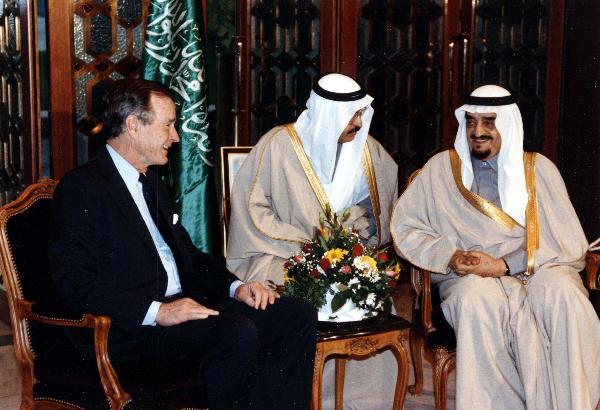
King Fahd, the fourth successor of Abdulaziz, meets with George H.W. Bush in 1992. In that year, King Fahd issued the Basic Law, which serves as Saudi Arabia’s constitution. Public Domain. George H.W. Bush Presidential Library and Museum.
Saudi Arabia, however, is not a strict theocracy. The state is controlled by a secular monarchy, that of the Al Saud dynasty. Unlike in Iran, religious authorities have no formal powers over the functioning of the state. Nevertheless, according to the original oath of Muhammad bin Saud and Abdal Wahhab, the Saudi state must adhere to Islamic principles. The king’s decrees are the basis for secular law but still must conform with religious law. The state and religious authorities are thus intertwined. The king is the physical protector of Islam's holiest sites while Abdal Wahhab's disciples and family members are in charge of official religious institutions. These include schools and most courts. Together, the monarchy and Wahhabi religious authorities combine to create a fully repressive system of governance.
The Basis of Law
Saudi Arabia's practices diverge from the Western concept of the rule of law in all respects (see Essential Principles). According to Article 7 of the Basic Law of 1992, the royal government's power is derived from the Koran and the Hadith. (The Hadith are the deeds and teachings of the Prophet Muhammad, including the practices of the faith or Sunna.) The constitution establishes Shari’a, a set of unitary legal interpretations by religious authorities, as the primary basis of law. The king appoints all members of the cabinet and government, including the Minister of Justice, who administers the Shari’a courts, and the Supreme Judicial Council, which appoints judicial officers for lower and appeals courts with the approval of the king.
Decisions of courts are based first on the strict interpretation of Wahhabism and second on the laws and decrees issued by the king. By custom, the king consults with tribal leaders on any proposed decree. He is also obliged to consult with members of the cabinet and the national council, or Majlis, both of which are appointed by the king. Regardless, the king has sole authority of approval. Some local authority rests in municipal councils with half of their members elected and half appointed by the king.
All aspects of life are controlled by Shari’a and the laws of the kingdom. Saudi law prohibits the sale of alcohol, use or sale of drugs, printed or visual material with sexual content and various forms of public entertainment (although recently a cinema and concerts have been approved). There is total control over the media and strict censorship. Journalists face severe punishment for publishing articles or opinions deemed critical of the government or insulting Islam.
Enforcement and Administration of the Law
In Saudi Arabia, Shari’a law is enforced by the Committee for the Propagation of Virtue and Prevention of Vice, informally known as the religious or morality police.
In Saudi Arabia, Shari’a law is enforced by the Committee for the Propagation of Virtue and Prevention of Vice, informally known as the religious or morality police. This is a semi-autonomous police force directly connected to the religious establishment. The government has other police forces for border security and the protection of the king. This last force is the largest, since it enforces all other domestic law.
All judicial officers are members of the religious establishment or ulama. They include several thousand judges (qadi), scholars, imams and other religious officials. The basic qualification is graduation from a religious college. Most courts have one judge and are mostly closed to the public. A high court of appeal exists, but the final arbiter of disputed cases is the king.
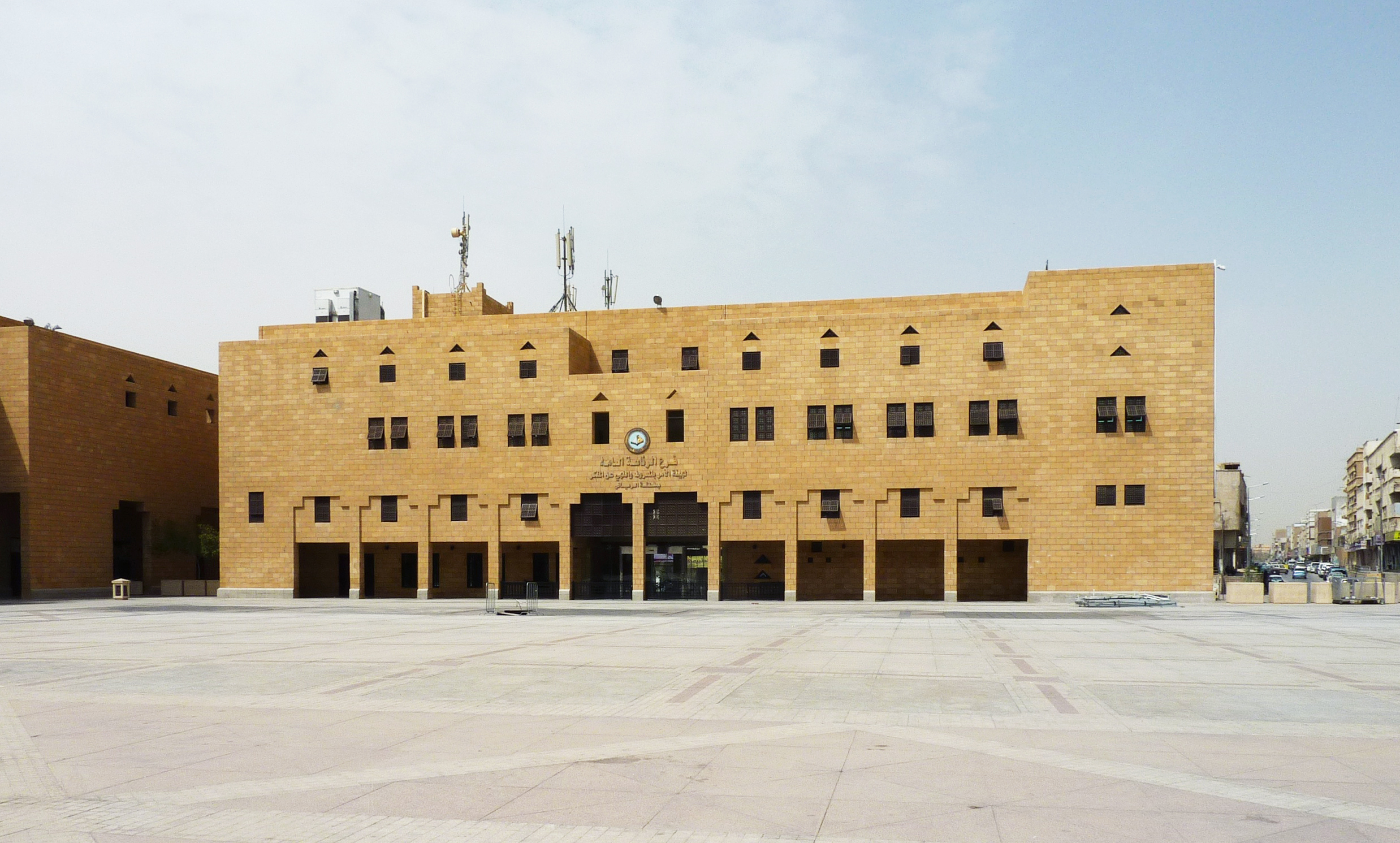
Dira Square in Riyadh, the capital, where public executions are carried out. Executions are ordered by Shari'a courts but must be approved by the king. Saudi Arabia has the third highest rte of executions in the world next to China and Iran. One hundred and seventy-two were carried out in 2023 according to Amnesty International. Creative Commons. Photo by: Luke Richard Thompson.
Cases are decided swiftly without due process. Although the new criminal code requires accused to have defense counsel, only the bravest of lawyers defend dissidents or challenge decisions through appeal.
A commission of religious experts issues guidelines for applying Shari’a law. In the Saudi application, the law is unitary, incorporating all four schools of Sunni Islamic law. The most respected and senior religious leaders comprise the Council of Senior Ulama, which has 30 to 40 members. The Council is responsible for relations between the government and the community.
Cases are decided swiftly without due process. Although the new criminal code requires accused to have defense counsel, only the bravest of lawyers defend dissidents or challenge decisions through appeal. Punishment is severe. Judges routinely impose long prison terms, lashings, amputations or death by beheading. The latter two punishments require the king’s approval.
Law Based on Discrimination
Public worship of other religions is banned. Private practice of other religions, including Shi’ite and Sufi branches of Islam, is allowed but discouraged and Shi’ite and Sufi Muslims are widely discriminated against.
Women are denied basic rights. Under Saudi law, women do not have self-guardianship, meaning that they must be represented by men in court and all other official settings.
Women are denied basic rights. Under Saudi law, women do not have self-guardianship, meaning that they must be represented by men in court and all other official settings. The religious police are accused of acting arbitrarily and harshly towards women. This includes punishing women for being raped.
Generally, women have been prevented from doing many things common in other societies, such as traveling abroad by themselves or driving freely, although reforms now allow these two activities by approval of a guardian. In cases of divorce, women often lose rights to their home, children and finances. Women must wear religiously approved clothing that covers their bodies and faces. Women are not permitted to mix with men in public places, such as mosques, shopping malls, eateries, hospitals and schools. Women have the right to vote and stand for office in municipal council elections, but participation in the councils themselves is restricted (see above).
The Absence of Spring
Unlike most countries in the Middle East, Saudi Arabia did not see uprisings or protests during the Arab Spring events of 2010–12. In fact, the government sent its own security forces to help quell protests in Bahrain and provided assistance to other monarchies to limit democratic reforms in the region. In 2013, the government also backed the military overthrow of President Morsi and Egypt’s Muslim Brotherhood-led government. In 2014, the king designated the Muslim Brotherhood and Hezbollah, a Lebanese-based armed Shi’ite movement tied to Iran, as terrorist organizations.
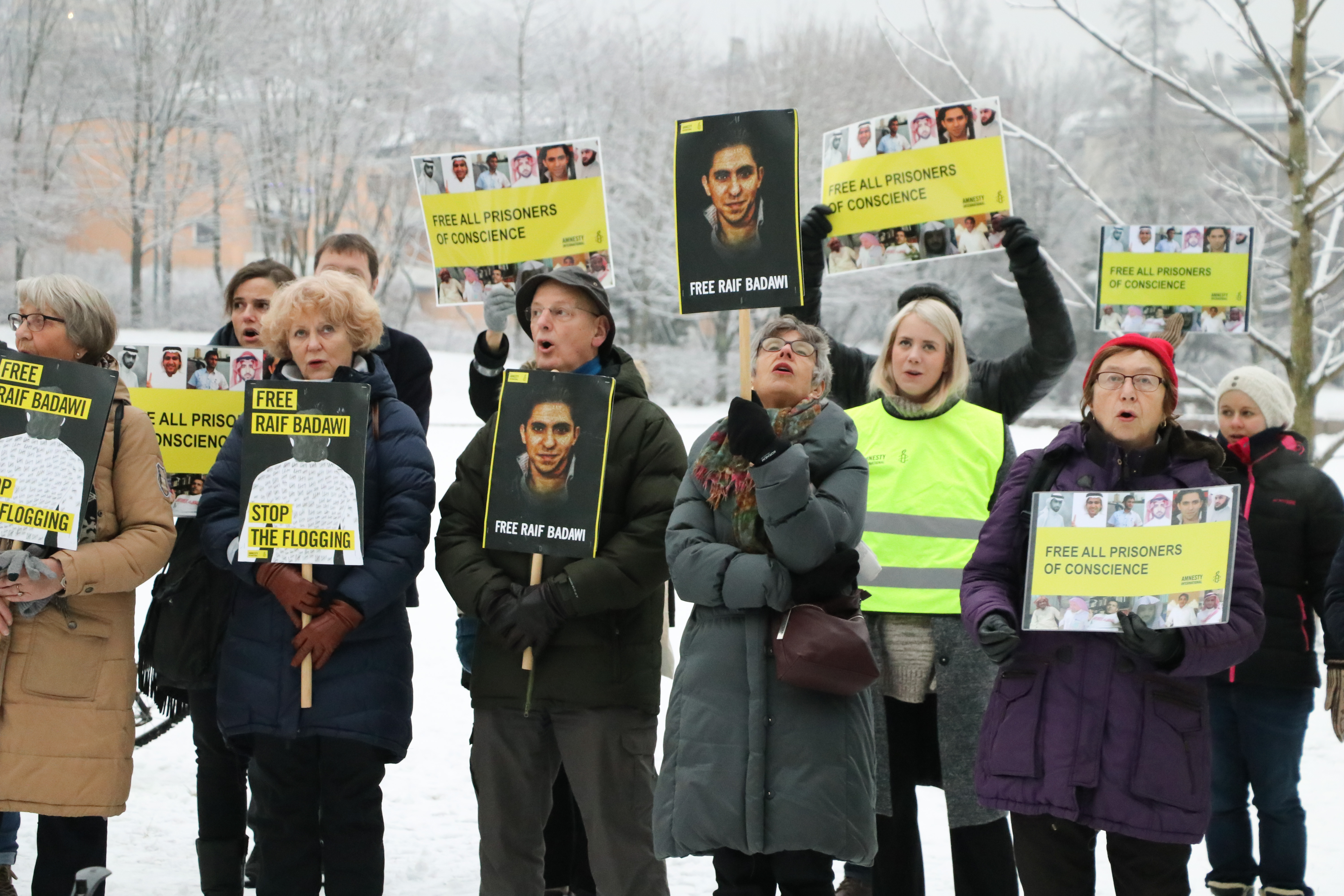
Raef Badawi, founder of the website Liberal Saudi Network, was sentenced to 10 years’ imprisonment and 1,000 lashes in 2014, prompting an international campaign in his defense. Above is a demonstration in Oslo in 2017 on his behalf. Badawi was released only in 2022. Creative Commons. Photo by: Etisk Forbund.
Despite being considered a modernist, King Abdullah continued government repression of most dissent, including human rights advocates, independent journalists, women seeking greater freedoms and representatives of the Shia and Sufi minority. For example, the Saudi Civil and Political Rights Association (ACPRA) was banned and its leaders sentenced to lengthy prison terms. In May 2014, Raef Badawi, founder of the website Liberal Saudi Network, was sentenced to 10 years’ imprisonment and 1,000 lashes (he was released in 2022). Soon after, Waleed Abu al-Khair, a lawyer and human rights activist, was sentenced to 15 years in prison for “disrespecting and offending the authorities.” More recent cases are described below.
Current Issues
King Abdullah’s death in 2015 began a transition in Saudi Arabia to next generation rule. Crown Prince Salman bin Abdulaziz, already 80 years old, assumed the crown. (Salman is considered the world’s richest ruler, having an estimated worth of $18 billion. The total worth of all royal family members is estimated at 1.5 trillion dollars.)
As king, Salman restructured the cabinet, appointed himself prime minster, and ensured a next-generation succession by naming his 30-year-old nephew, Muhammad bin Nayef, as Crown Prince. His own son, Mohammed bin Salman, was named deputy crown prince and appointed Minister of Defense. In that position, he pursued an aggressive foreign policy to reduce Iran’s influence in the region by launching a war against Houthi rebels in Yemen and ordering a blockade on Qatar, an Iranian ally.
In 2017, King Salman replaced Muhammad bin Nayef with his son and delegated much of his authority to the new Crown Prince and heir. As a surrogate monarch, Mohammed bin Salman quickly consolidated his power. As head of an anti-corruption committee, he ordered the detention of more than 300 royal members and removed them from government and economic positions. Most were forced to turn over their assets to gain release. In 2020, Muhammad bin Nayef was detained along with his half-brother and uncle on charges of treason. They remain under detention.
Mohammed bin Salman (often referred to by his initials MBS) has tried to put his imprint on Saudi Arabia. In 2016, he put forward a modernist policy in the form of Vision 2030 (see Resources). It calls for lessening dependence on oil revenues and transforming the economy based on new investments and technologies. As part of modernization, he introduced some reforms, such as removing the ban on women to drive, weakening the guardianship system and opening a cinema.
Yet King Salman and Crown Prince Mohammed maintained the repressive policies of Abdullah, ordering severe punishments on political and religious dissidents and resuming executions after a brief hiatus. In Salman’s first year, 2015, forty-seven people were executed, most for drug-related offenses. A cleric who had joined 2011–12 protests against Shi’ite discrimination in the eastern provinces was also executed resulting in the formal break at the time of diplomatic relations between Iran and Saudi Arabia.
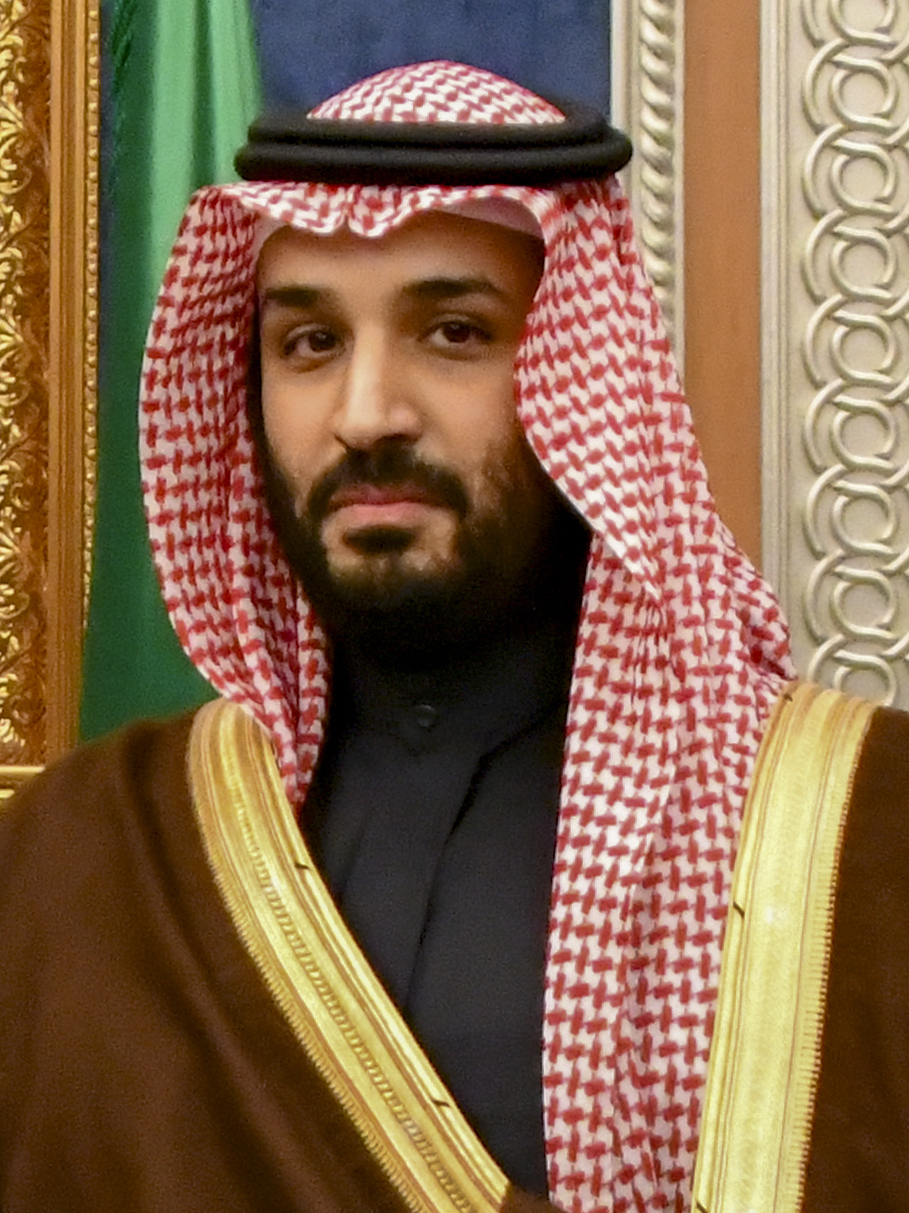
Crown Prince Mohammed bin Salman, the first of the next generation to lead Saudi Arabia, gained governing authority from his father, King Salman. He consolidated power by ruthless means and even carried out extrajudicial murder overseas of opponents of the regime. Shown here in 2019 on a trip to the United States. Public Domain. US Department of State.
Crown Prince Mohammed, having placed allies in key security positions, is known for ordering particularly harsh repression. The most chilling act was the murder abroad of Jamal Khashoggi. A former Saudi insider turned dissident, Khashoggi lived as a permanent resident in the United States and became well-known as an advocate for free speech and reform through a regular column in The Washington Post (see Resources). Seeking to update his passport, he went to the Saudi consulate in Istanbul, Turkey on October 2, 2018. There, he was murdered by a Saudi security team and it is likely his body was dismembered to prevent the remains from being found.
The shocking murder led to demands by the US Congress to sanction Saudi Arabia, but then-President Donald Trump favored relations with the regime and deflected blame from the Crown Prince. According to news reports, the Central Intelligence Agency confirmed that Mohammed bin Salman ordered the murder but its findings were classified. The Crown Prince claimed the murder was carried out by five rogue security personnel, who were sentenced to death in December 2019. Higher-ups were let go for lack of evidence.
In 2021, the new president, Joseph R. Biden, who had promised to isolate Saudi Arabia, declassified the CIA report revealing clear evidence of top-level involvement. But the president reversed his isolation policy and traveled to Saudi Arabia to engage in regional diplomacy efforts. Diplomatic pressure around Biden’s visit reportedly led to the release of Loujain al-Hathloul, who had served three years of a long sentence for advocating for women’s rights. She remains under a travel and speech ban.
The Crown Prince has continued to try to present himself as a “modernizer” to the West . . . [b]ut no significant political reforms have been introduced.
All web sites and blogs require government permission to publish. Any criticism of the government or religious authorities is banned. As of December 2022, the Committee to Protect Journalists reported that 11 journalists were imprisoned. In fact, any form of free expression is harshly repressed. In August 2022, Salma al-Shehab was sentenced to 34 years’ imprisonment for possessing a banned book and sharing Twitter posts of dissidents. Noura al-Qahtani was sentenced to 45 years’ imprisonment for “spreading lies” about the government on social media posts. There are dozens serving harsh sentences for such crimes.
In December 2022, King Salman designated his son prime minister in a move widely interpreted as shielding Crown Prince Mohammed from international action for the Khashoggi murder. The Crown Prince has continued to try to present himself as a “modernizer” to the West, including through “sports washing” and holding international events like the Future Investment Initiative. But no significant political reforms have been introduced. As well, the regime reintroduced executions in 2022 after a two-year moratorium. The European Saudi Organization for Human Rights reported a record 147 persons were put to death, most often by beheading. Amnesty International reported 172 executions in 2023 — third highest in the world next to China and Iran.
In recent foreign policy, the regime has changed its stance toward Iran. It reached a truce with Houthi rebels in Yemen, ended the blockade of Qatar and normalized relations with Iran. It also has engaged in negotiations with the U.S. to normalize relations with Israel. (Negotiations reportedly have continued as part of a US effort to end the Israel-Hamas war that began on October 7, 2023.)
The content on this page was last updated on .